The best co-op games give everyone something meaningful to do, whether that means solving a puzzle together, surviving a frantic firefight, or keeping a kitchen from collapsing into chaos. These ten picks cover two-player adventures, group game nights, and longer shared projects. Use the recommendations below to match your friends’ interests, preferred pace, and playing setup—not just the highest spot on a ranking.
Which co-op games should you play with friends?
Start with It Takes Two for a dedicated two-person adventure, Overcooked! All You Can Eat for party-night teamwork, or Deep Rock Galactic for cooperative shooting. Those are my starting recommendations for three different moods, rather than interchangeable choices. The right pick depends on whether your group wants to follow a story, coordinate under pressure, or settle into repeatable missions.
Before choosing, agree on three things:
- Who is playing: Pick for the actual group, including anyone less comfortable with controllers.
- Where everyone will be: Decide between sharing one screen and connecting from separate homes.
- What success looks like: Finishing a chapter, improving a score, and building a shared farm offer very different evenings.
1. It Takes Two — Best for a Dedicated Duo
It Takes Two is built exclusively around two-player cooperation, with platforming challenges designed for a pair rather than a solo player with backup. It supports couch and online play, and a Friend’s Pass lets an owner invite a partner without requiring another full-game purchase. Nintendo Switch players can also play together locally or online with compatible Switch versions. (ea.com)
Choose it when you and one friend want an adventure to return to together. Give each other room to experiment instead of having the more experienced player direct every move. Treating mistakes as shared discoveries is a better approach than racing through the next obstacle.
2. Split Fiction — Best for Constant Variety
Split Fiction follows Mio and Zoe, writers trapped inside sci-fi and fantasy worlds. Its two-player adventure switches between mechanics and abilities, including platforming, puzzles, and stealth. Local co-op, online cross-play across supported platforms, and Friend’s Pass support give a pair several ways to team up. (ea.com)
This is my recommendation for friends who enjoy learning something new rather than repeating one familiar routine. Pause to explain what you think your character can do before attempting a coordinated sequence. That small habit keeps experimentation collaborative instead of turning every failed attempt into a guessing game.
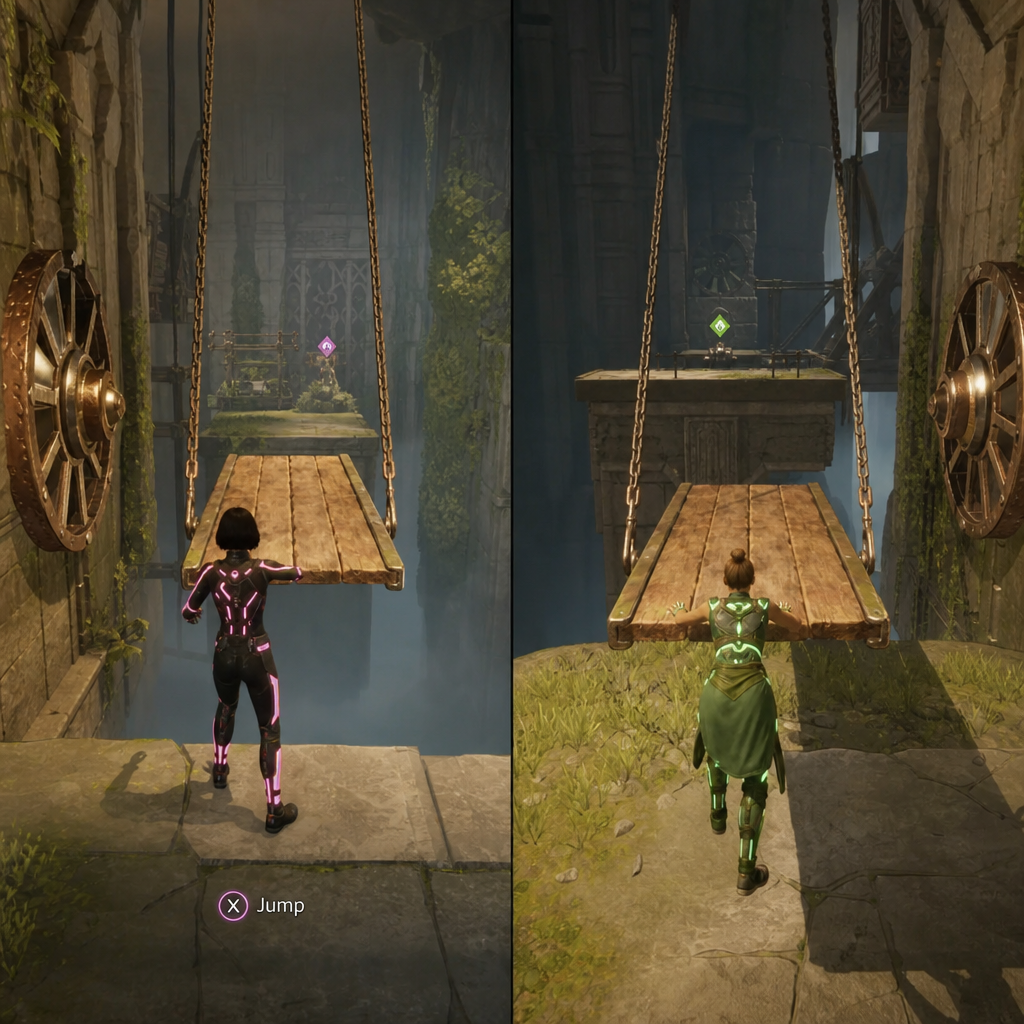
3. Overcooked! All You Can Eat — Best for Party-Night Chaos
This collection combines the first two Overcooked! games and their additional content, with local and online cooperation for up to four players. Cross-platform multiplayer helps friends on different systems join the same kitchen, while assist options offer ways to adjust the challenge. Your team prepares and serves orders while managing the kitchen’s demands. (team17.com)
Among couch co-op games, this is my pick for groups that enjoy lively, slightly ridiculous coordination. Start by assigning preparation, cooking, and serving responsibilities. When that arrangement breaks down, discuss the bottleneck rather than blaming whoever happens to be holding the unfinished dish.
4. Portal 2 — Best for Puzzle-Solving Partners
Portal 2 gives two players a dedicated cooperative campaign with its own story, characters, and test chambers. Its portal-based puzzles require partners to think together, not simply complete separate tasks in the same room. The cooperative campaign is distinct from the single-player adventure. (store.steampowered.com)
Pick it if your favorite gaming moment is a shared realization rather than a narrow escape. Describe your proposed solution before acting, especially when timing matters. If one friend spots the answer immediately, let the other work through the logic too; discovering why a solution works is much more satisfying than following instructions blindly.
5. Deep Rock Galactic — Best for Mission-Based Shooting
Deep Rock Galactic sends teams of up to four dwarven miners into hostile alien caves to complete objectives and gather resources. Shooting sits alongside exploration and excavation, with destructible environments and equipment that helps the team navigate underground. That combination makes it more than a sequence of firefights. (deeprockgalactic.com)
For friends seeking FPS co-op, this is my choice when the group wants a job to accomplish together. Discuss responsibilities before heading into a mission, then keep communicating as conditions change. Focus on getting the whole team through rather than treating individual combat performance as the only measure of contribution.
6. Left 4 Dead 2 — Best for Horror-Shooter Fans
Left 4 Dead 2 puts a four-survivor team into a zombie-apocalypse shooter with firearms, melee weapons, and dangerous special infected. Its AI Director adjusts elements of the action according to the team’s performance, helping familiar campaigns produce different situations. Expect action-horror rather than a gentle social backdrop. (store.steampowered.com)
Choose it when your friends want urgency and enjoy rescuing each other from trouble. Agree to move together instead of letting the fastest player dictate the pace. For a first session, prioritize clear communication and learning the threats over proving how aggressively everyone can push forward.
7. Stardew Valley — Best for a Shared Long-Term Project
Stardew Valley offers multiplayer farming alongside activities such as fishing and exploration, and it supports local split-screen on supported versions. Online group limits and multiplayer options vary by platform. The host keeps the shared farm’s save, so other players depend on that host making the world available. (wiki.stardewvalley.net)
I recommend it for friends who would rather build something together than chase constant action. Agree on one shared goal while leaving room for individual interests. Also choose a reliable host before investing in the farm; organizing around someone’s availability is easier when everyone understands that arrangement from the beginning.
8. Minecraft Dungeons — Best for Dungeon-Crawling Together
Minecraft Dungeons turns the Minecraft setting into an action-adventure inspired by classic dungeon crawlers. Up to four players can battle together online or through couch co-op, making it an option for both remote friends and a group sharing a screen. This recommendation is for the original Minecraft Dungeons. (minecraft.net)
Choose it when your group wants a shared combat adventure rather than an open-ended building project. Let everyone explore the experience before deciding how seriously to pursue progression. For an introductory evening, make the goal completing an adventure together, not rushing a less experienced friend toward whatever comes next.
9. Lovers in a Dangerous Spacetime — Best for Shared-Screen Teamwork
This space adventure puts two to four local players aboard one battleship, moving between weapons, shields, and engines. Everyone contributes to operating the same vessel instead of steering a separate ship. The developer explicitly lists local multiplayer without native network support, so plan this one for an in-person gathering. (loversinadangerousspacetime.com)
It earns a place among these top co-op games because the shared responsibility is the appeal. Rotate stations so nobody feels permanently assigned to a job they dislike. Use short calls such as “taking shields” or “need a pilot” to make your intentions clear without filling every moment with instructions.
10. Unravel Two — Best for Supportive Platforming
Unravel Two connects two Yarnys with a thread used for swinging, pulling, and creating bridges. It supports two-player local cooperation, including on Nintendo Switch. Its mechanics also let the characters merge for movement, and the game provides hints and slow motion for tricky sections. (eaassets-a.akamaihd.net)
If you are comparing 2 player Switch games, put this on your shortlist for a quieter shared adventure. Take turns leading the exploration and suggesting puzzle solutions. Resist solving every obstacle for your partner; offer a hint first, then let them decide whether they want more help or another attempt.
How do you choose good co-op games for your group?
Choose good co-op games by matching the experience to your least flexible requirement first: player count, playing location, or preferred intensity. Then consider the kind of cooperation everyone enjoys. A strong recommendation for one pair can still be the wrong choice for a larger group or a friend who dislikes pressure.
Use this final checklist before committing:
- Verify your exact editions. Check each game’s official listing for your hardware and intended multiplayer setup.
- Choose a manageable first goal. Aim for an introductory session rather than committing everyone to a lengthy campaign immediately.
- Agree on coaching. Ask whether friends want advice, hints, or time to experiment independently.
- Reassess after playing. Decide together whether to continue, adjust the challenge, or try another style.
The best coop games for your friends are the ones everyone wants to reopen. Pick one that suits tonight’s group, give each player room to contribute, and let the shared experience matter more than playing perfectly.
And if co-op is the genre you’re building, not just playing — private rooms, friend invites, session persistence and realtime sync are the pieces our own games run on at api.michitai.com.
Try Mafia Deck Online
Releases November 5 on Steam — US$3 with a 40% launch discount. Wishlist it now.
Related: Top 10 Two Player Games Online · Top 10 Accusation Party Games · Social Deduction Games Guide