The best two player games online give you something worth sharing: a clever rivalry, a satisfying puzzle, or an adventure that needs both of you. This selection covers ten options, from browser-based board games to downloadable cooperative campaigns. You’ll find what makes each game appealing, how to play together, and practical tips for choosing one that suits your devices and mood.
Which online two-player games should you try first?
Start with chess, Connect 4, or Battleship if you want browser-based competition; choose Portal 2 or We Were Here for cooperative puzzles. For an adventure built around two people, consider It Takes Two. These choices support remote play, rather than requiring you to share a keyboard. Their different formats let you choose between a competitive match and a shared campaign. (lichess.org)
This list prioritizes variety and useful two-player experiences, not a universal ranking. Before choosing, agree on three things: whether you want to compete or cooperate, whether downloading is acceptable, and whether either person wants to spend money. That conversation can save you from spending your gaming time troubleshooting the wrong choice.
Ten games worth sharing with a friend
1. Chess on Lichess — For thoughtful competition
Lichess offers free online chess alongside lessons, puzzles, analysis tools, and friend challenges. It’s a strong starting point if you want online 2 player games that reward learning rather than unlocking equipment. You can revisit mistakes afterward instead of immediately starting another match. (lichess.org)
Choose a generous time control for your first games together. Rushing makes it harder to explain ideas or notice why a move failed. If your skill levels differ, try discussing the position after each game and let the less experienced player identify one turning point before opening the analysis. Make improvement a shared project, even while competing.
2. Connect 4 on papergames.io — For an easy starting point
Connect 4 is a straightforward pick when neither person wants to study a rulebook. On papergames.io, you can play free in a desktop or mobile browser, including as a guest. The platform also offers larger board configurations if you want to move beyond the classic layout. (papergames.io)
Start with the standard board and alternate who moves first. Look for opportunities to create two winning threats at once, rather than chasing a single obvious line. A short series works well here: it gives both players room to experiment without making one careless move feel like the entire evening’s result.
3. Battleship on papergames.io — For deduction with surprises
Battleship turns a hidden fleet into a contest of searching and narrowing possibilities. The papergames.io version runs free in your browser, with randomly placed ships and bonus weapons that can appear through gifts. It also lets a player fire again after scoring a hit, so this version differs from some familiar tabletop rules. (papergames.io)
Read those rules together before starting. Once you find a ship, focus on nearby squares rather than abandoning the clue for another random shot. Choose this when you want something easy to understand but less dependent on seeing the entire board than chess or Connect 4.
4. Jaipur on Board Game Arena — For tactical trading
Jaipur is a two-player trading game about collecting, exchanging, and selling goods. Board Game Arena provides a browser adaptation, so there’s no game client to install. Selling larger sets can earn bonuses, while earlier sales can secure more valuable goods tokens. (go.boardgamearena.com)
That creates an appealing dilemma: cash in now or keep collecting? Try watching what your opponent takes, not just what would improve your own hand. If they’re gathering the same goods, waiting may become expensive. Jaipur is worth considering when you want a card-game contest with meaningful decisions but no need for fast reactions or elaborate controls.
5. 7 Wonders Duel on Board Game Arena — For layered strategy
7 Wonders Duel puts two civilizations into direct competition over resources, buildings, and wonders. Its browser version on Board Game Arena supports exactly two players. In the base game, military or scientific supremacy can end the contest immediately; otherwise, victory points decide the winner. (en.boardgamearena.com)
Don’t treat it as a race to collect attractive cards. Before choosing, check whether your move exposes something your opponent urgently needs. For your first match, focus on understanding the victory conditions rather than perfect efficiency. It’s a good next step when simpler two player internet games leave you wanting more interconnected decisions.
6. Patchwork on Board Game Arena — For spatial planning
Patchwork asks each player to build a quilt from differently shaped pieces while managing buttons and time. Board Game Arena’s browser adaptation preserves that balance: a patch must fit your board, but its price and time cost matter too. Empty spaces reduce your final score. (en.studio.mobile.boardgamearena.com)
Resist buying a piece solely because it fills an awkward gap. Consider what it leaves you able to afford and how it changes the available choices. Pick Patchwork if you enjoy visual planning and want a competitive game without combat. It offers a different kind of tension: making a tidy plan while your opponent changes the market.
7. Brawlhalla — For energetic head-to-head matches
Brawlhalla is a free platform fighting game with online play and cross-play across its supported platforms. Custom lobbies let friends play together, making it an option when you aren’t using matching hardware. Unlike the browser games above, it requires installing the game. (brawlhalla.com)
Treat your opening matches as practice rather than a serious competition. Choose a character you like, learn how to recover after being knocked away, and agree to test attacks before keeping score. If one player already knows the game, take turns setting a small challenge. Learning one technique together is more welcoming than repeatedly winning through unfamiliar tricks.
8. Portal 2 — For shared problem-solving
Portal 2 includes online cooperative play and a dedicated two-person campaign separate from its single-player story. Its test chambers require you to think together, not simply stand beside each other while completing independent tasks. The Steam edition is a paid download. (store.steampowered.com)
Choose it when you enjoy talking through an idea and then testing it. Before acting, explain what you expect your partner to do and what the result should be. If one person solves a chamber first, offer a hint rather than issuing every instruction. The satisfaction comes from reaching the answer together, not having one player operate as a passenger.
9. We Were Here — For communication challenges
We Were Here separates two players inside a mysterious castle, giving each a different perspective on its puzzles. Progress depends on describing information through voice communication. The original game is free on Steam, and its PC listing requires both players to have working microphones. (store.steampowered.com)
Test your audio before starting and resist sharing screenshots that reveal the answer. Instead, describe shapes, positions, and patterns precisely, then repeat important details back to confirm them. Among two person games online, this is a particularly good fit for partners who want communication itself to become the challenge. Pick it for focused collaboration rather than background conversation.
10. It Takes Two — For a dedicated cooperative adventure
It Takes Two is a cooperative action-adventure built around two players. Friend’s Pass lets someone who owns the full game invite a partner who doesn’t; both can also try the first chapter without owning it. Installation and applicable accounts are required, and console online play may require subscriptions. (ea.com)
Choose this when you want an ongoing shared experience rather than isolated matches. Set aside time for both players to learn unfamiliar mechanics, and avoid having the more confident person dictate every solution. Before downloading, check the current compatibility guidance for your exact platforms and editions, especially if you’re playing on different systems.
How do you choose the right game for both players?
Choose games to play two-player by matching the experience to the less comfortable player’s needs. Agree on the pace, setup effort, and competitive intensity before committing. Whether a site labels them double player games or dual player games matters less than whether both people can participate confidently.
Use this checklist:
- Decide the mood: Do you want a rivalry, a puzzle, or an unfolding adventure?
- Check access: Confirm devices, installation requirements, accounts, and any purchase or subscription needs.
- Check hosting costs: Board Game Arena requires a Premium member to create tables for Premium games; non-Premium friends can join those tables. (w.boardgamearena.com)
- Agree on help: Decide whether hints, coaching, or outside guides would improve the experience.
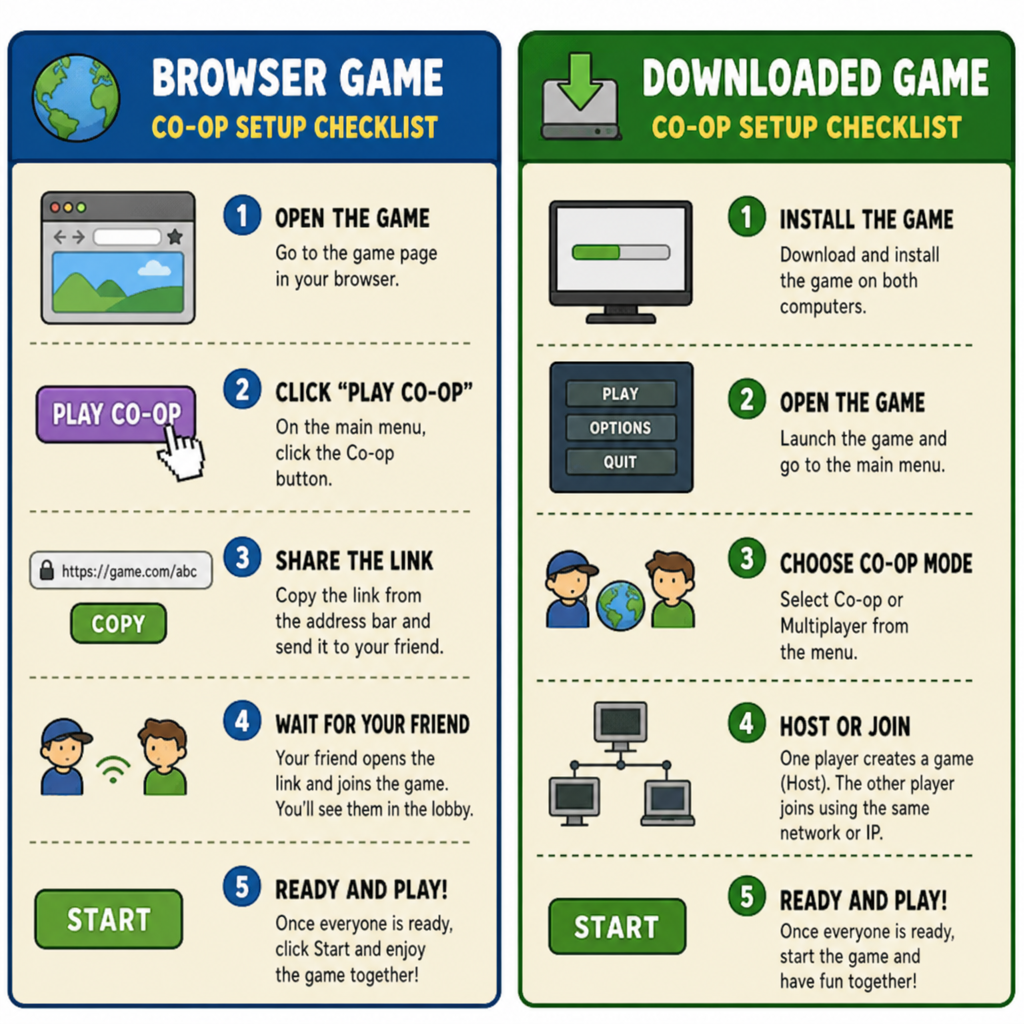
Start with one game, not ten
Pick one option that fits both players, learn it together, and give yourselves permission to be beginners. Keep a competitive choice and a cooperative choice in reserve for different moods. The best session isn’t necessarily the one you win—it’s the one both of you want to repeat.
And if you’re building the next two-player game yourself — our own titles run on the multiplayer backend we operate at api.michitai.com.
Try Mafia Deck Online
Releases November 5 on Steam — US$3 with a 40% launch discount. Wishlist it now.
Related: Top 10 Accusation Party Games · Games Like Among Us · Social Deduction Games Guide