Online social deduction games turn hidden identities, conflicting goals, and player conversations into the central challenge. Their rise reached a defining moment with Among Us, which launched in 2018 before breaking through in 2020, helped by content creators sharing its mix of cooperation and betrayal. Understanding that appeal—and choosing the right setup—can help you turn a game night into something more memorable than another routine multiplayer session. (unity.com)
What is an online social deduction game?
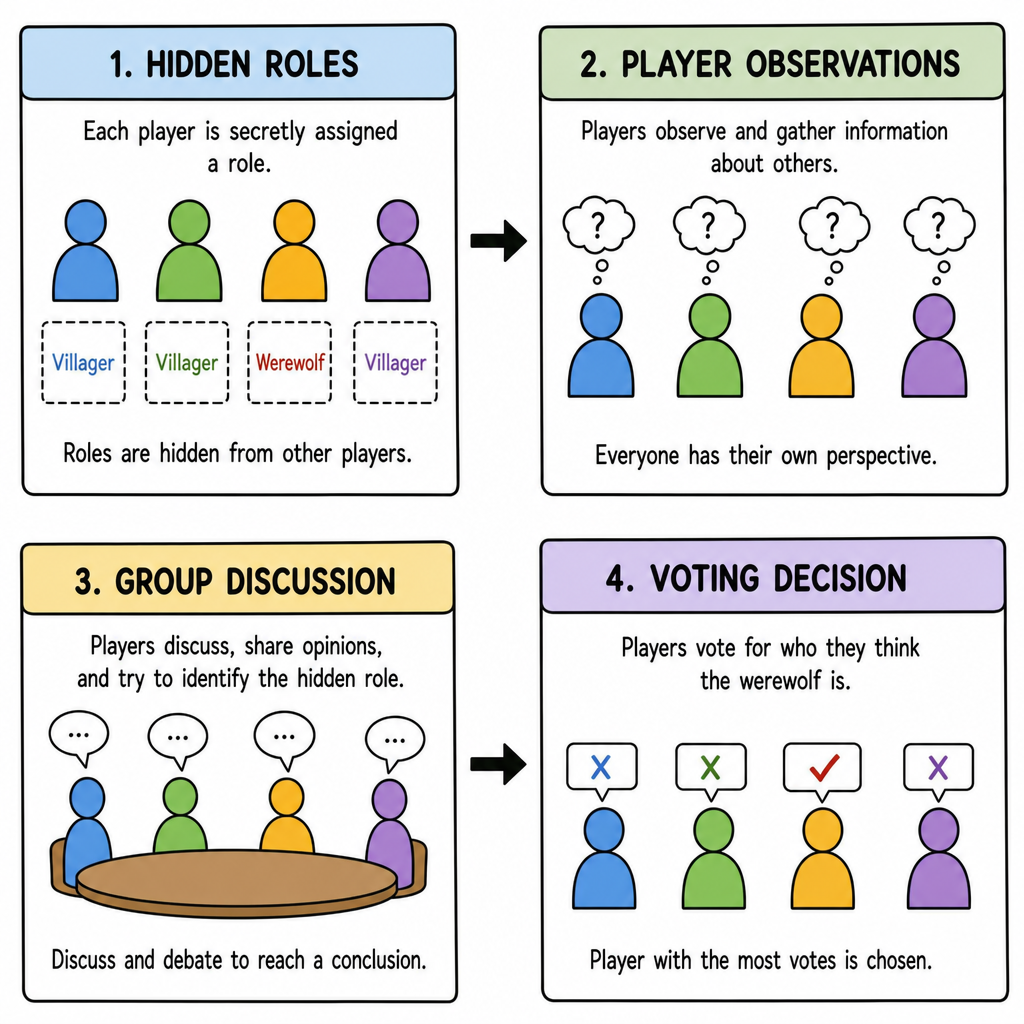
An online multiplayer social deduction game asks players to work out whom they can trust while some participants secretly pursue opposing objectives. Instead of relying only on reflexes or visible scores, players interpret actions, compare accounts, and decide whether another person’s explanation holds up. Among Us illustrates the format: Crewmates complete tasks and identify Impostors, while Impostors undermine the group and try to avoid detection. (innersloth.com)
The distinction is not simply that someone can lie. It is that players must make consequential decisions without having the full picture. In Among Us, for example, emergency meetings and votes connect suspicious behavior to the possibility of ejecting another player. An accusation becomes part of the game rather than just background conversation. (innersloth.com)
Think of a hypothetical meeting: one player says they crossed a room alone, while another claims to have seen them with someone else. That contradiction creates several possibilities. Someone might be lying, remembering incorrectly, or describing a different moment. Sorting those possibilities is the heart of the puzzle.
From a quiet launch to a shared online experience
The genre’s modern rise is closely associated with Among Us, but its breakthrough was not immediate. Unity’s account of the game’s development traces its June 2018 launch, early attention from South Korean creators, and later exposure through Brazilian YouTubers before its much larger surge in 2020. That history matters: the audience developed through communities sharing the experience, not simply through a successful release day. (unity.com)
Sensor Tower’s September 2020 reporting also connected the game’s rapid download growth with expanding coverage on YouTube and Twitch. The evidence supports a clear role for creators in its discovery, rather than suggesting that popularity appeared out of nowhere. (sensortower.com)
One reasonable interpretation is that social deduction gives creators an especially useful storytelling framework. Viewers can watch someone establish an alibi, notice a contradiction, and attempt a last-minute defense. Those moments turn the rules into a story with recognizable stakes. That interpretation fits the documented connection between creator coverage and the game’s breakout, although it does not establish a single cause for its success. (innersloth.com)
For your own game night, the lesson is practical: prioritize opportunities for interaction over a complicated feature list. Give everyone enough understanding to participate, then leave room for surprising decisions.
Why does the format work as an online party game?
The format can work as an online party game because conversation is part of the objective, not something players must create around it. In Among Us, players have reasons to explain their movements, defend themselves, and question others. Jackbox’s Push the Button takes another approach, asking players to scrutinize written responses, drawings, and choices to identify hidden aliens. Both designs give the group something specific to discuss. (innersloth.com)
That offers a useful way to assess an online social game: look at what people will actually say and do together. Will they reconstruct events? Debate unusual answers? Coordinate actions while questioning someone’s motives? Choose the kind of conversation your group enjoys, rather than assuming every deception game produces the same atmosphere.
Consider three possible priorities:
- A relaxed catch-up: Favor clear objectives and leave time between rounds for ordinary conversation.
- A theatrical evening: Encourage playful defenses and dramatic accusations, while keeping personal comments off limits.
- A competitive puzzle: Agree to focus on observable events, consistent rules, and explanations that other players can test.
You do not need to choose one mood forever. Start with a shared expectation so one person’s serious investigation does not collide with everyone else’s comedy night.
The strategy is in the evidence, not just the bluff
Calling the format a social strategy game is useful because deception alone is an incomplete description. Among Us gives Crewmates tasks, surveillance tools, sabotage to address, and voting decisions; Impostors must blend in while interfering with the crew. Those mechanics create information and competing pressures beyond whatever players say in meetings. (innersloth.com)
If you are investigating, separate observations from interpretations. “I saw someone enter the room” is an observation. “They entered because they were planning an attack” is an interpretation. Present the first clearly before arguing for the second, and invite others to supply missing context.
If you have a deceptive role, build your explanation around the actual situation. In a hypothetical round, claiming to have crossed the entire map may create more questions than acknowledging part of a route someone witnessed. Treat every extra invented detail as another point you may need to explain later.
Try these habits during discussion:
- Build a timeline: Ask what happened immediately before and after the disputed event.
- Check alternatives: Consider whether confusion or incomplete visibility could explain an inconsistency.
- Request specifics: Ask about locations and actions rather than demanding that someone “sound innocent.”
- Update your view: Explain when new information changes your original suspicion.
Use these as reasoning prompts, not guarantees of finding the hidden opponent.
How do you choose social deduction games online?
Choose social deduction games online by matching their communication style, setup requirements, and complexity to your actual group. Before committing, check the official game information for supported devices, player limits, joining instructions, and available communication options. Then decide whether your friends would rather track movement and tasks or interpret answers and creative choices—the contrast between Among Us and Push the Button provides a useful starting point. (innersloth.com)
Match the interaction to the players
Ask everyone how they prefer to communicate. If someone cannot comfortably use voice chat, make text support a selection requirement rather than an afterthought. If your group includes new players, choose a setup you can explain without introducing a long list of exceptions.
Also decide whether you want a private gathering or a session with unfamiliar players. For a first evening, consider inviting a known group so you can agree on etiquette and pause for explanations. Treat that as a hosting choice, not a promise that every private lobby will run smoothly.
Check the practical details before inviting everyone
Use this checklist before settling on a multiplayer social game:
- Devices and access: Confirm that everyone can join through a supported platform and understands what they need to install or open.
- Group size: Check both the official limits and whether your planned setup suits the number attending.
- Participation: Read what happens after elimination so nobody is surprised by waiting or restricted involvement.
- Communication: Verify the chat arrangement and test it before starting.
- Content and controls: Review age guidance and available safety settings, especially when younger players are involved.
Send the joining instructions in advance. Use the scheduled start for a practice round rather than troubleshooting everyone’s setup simultaneously.
Hosting a session people want to repeat
For your first session, prioritize clarity over variety. Explain the objectives, how discussion works, and any restrictions on sharing information. Use a practice round to demonstrate the sequence without treating mistakes as serious failures.
Set a boundary between in-game deception and personal treatment. Encourage players to challenge a claim, not insult the person making it. Ask eliminated players to follow the game’s information rules, and agree that outside messages should not be used to reveal secrets.
Give quieter participants space without forcing them to perform. Before a vote, invite anyone with an unshared observation to contribute. If discussion becomes circular, summarize the competing explanations and identify what remains uncertain.
Afterward, ask one concrete question: was the round confusing, rushed, or too slow? Change one setting or hosting habit at a time so the next session addresses an identifiable problem.
The lasting appeal is a shared mystery
The rise of online social deduction is more than a story about one breakout title. It offers a model for making conversation consequential: players need one another’s information while having reasons to question it. That tension is visible in both the task-driven deception of Among Us and the response-based investigations of Push the Button. (innersloth.com)
For your next game night, start with a format your group can understand, establish fair boundaries, and let the mystery develop. Aim for a session where even a mistaken accusation becomes a story worth retelling.
Try Mafia Deck Online
Releases November 5 on Steam — US$3 with a 40% launch discount. Wishlist it now.
Related: Social Deduction Games Guide · Games Like Among Us · Best Mafia Games